Memorable Monument Valley — Holy Ground, Horses and an Off-Grid Hogan
Part 2: During our sojourn to Memorable Monument Valley, we explored iconic sandstone monoliths, trekked less-traveled trails on horseback, and lodged in a sacred, off-grid Navajo hogan.
ROAD TRIPPING THE SOUTHWEST
"My third visit to Monument Valley — and Jerry's first — on a weeklong Utah road trip we fondly remember."
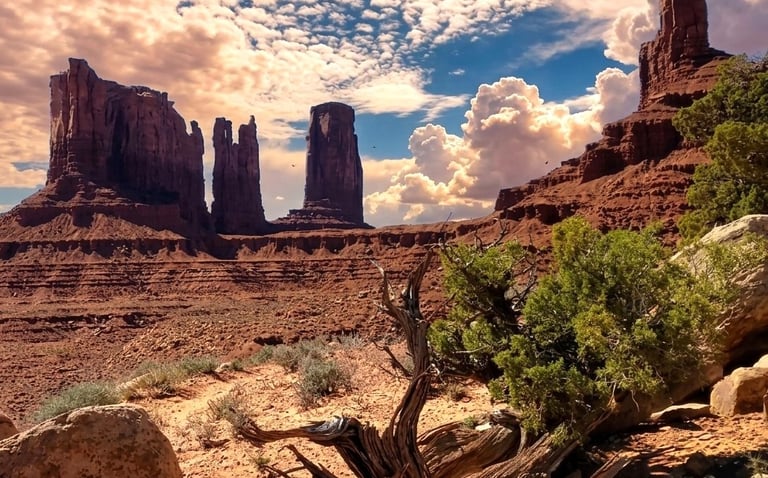
Long before John Ford made it the backdrop of the American West, and before the Marlboro Man leaned against its buttes, Monument Valley was already ancient. The Ancestral Puebloans lived among this landscape. For centuries, the Navajo have called this sacred land their home. Some sites sway you with significance — and you feel Monument Valley's pull the moment those majestic, rust-red monoliths come into view.
Situated within the Navajo Nation Reservation, Tsé Biiʼ Ndzisgaii is the Navajo name for Monument Valley — meaning "the streaks that go around in the rocks" or "valley of the rocks.” The area features stunning red iron oxide sand and colossal sandstone structures that rise from 400 to 1,000 feet.
Although this was Jerry's first visit and my third, the land and the vibe felt new yet familiar to me the instant I spotted those iconic giants. That dichotomy — my familiarity, his first-timer wonder — made the experience richer for both of us.
We arrived as part of a weeklong road trip to Utah, where — with great anticipation and shared preplanning — we covered a great deal of ground and made some amazing memories.
The road trip itself was half the joy — impromptu stops to ponder odd curiosities, and photo ops materializing ‘round every bend. Being in the right vehicle for the terrain is important in backcountry like this, and my Toyota FJ Cruiser handled our off-roading like a champion.
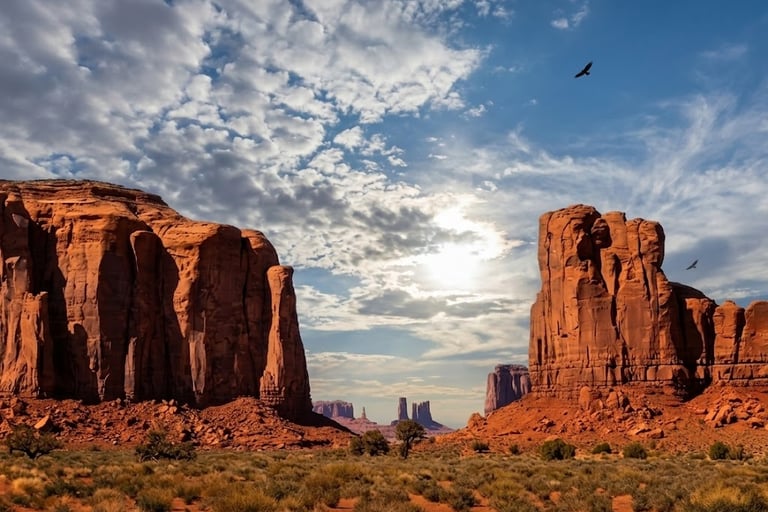
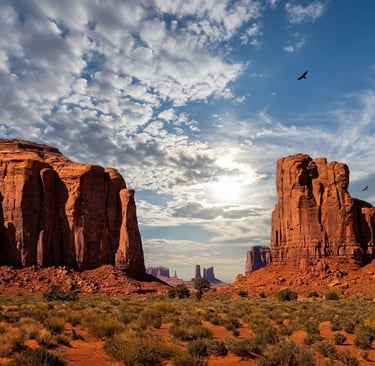
Artist's Point gave us perhaps the most expansive view of all — one of those vistas where the eye doesn't know where to rest, so it keeps moving, horizon to horizon — in small sips and long swallows. North Window framed the valley between two massive stone walls — like a portal someone had left open.
Before stepping into any of the ancient sites along the loop, we sprinkled our pre-mixed blends of cornmeal and tobacco — offerings to the Ancient Ones. It is the least a visitor can do: acknowledge, with something tangible, that you are a guest on consecrated ground.
The dusty, rutted 17-mile loop of Monument Pass is no place for a timid vehicle or a hurried driver. The primitive dirt road punishes a tire that meets its ruts at speed. We drove slow to prevent billowing dust from ruining the scenic drive for those behind us. Turns out, courtesy and self-preservation point in the same direction out here.
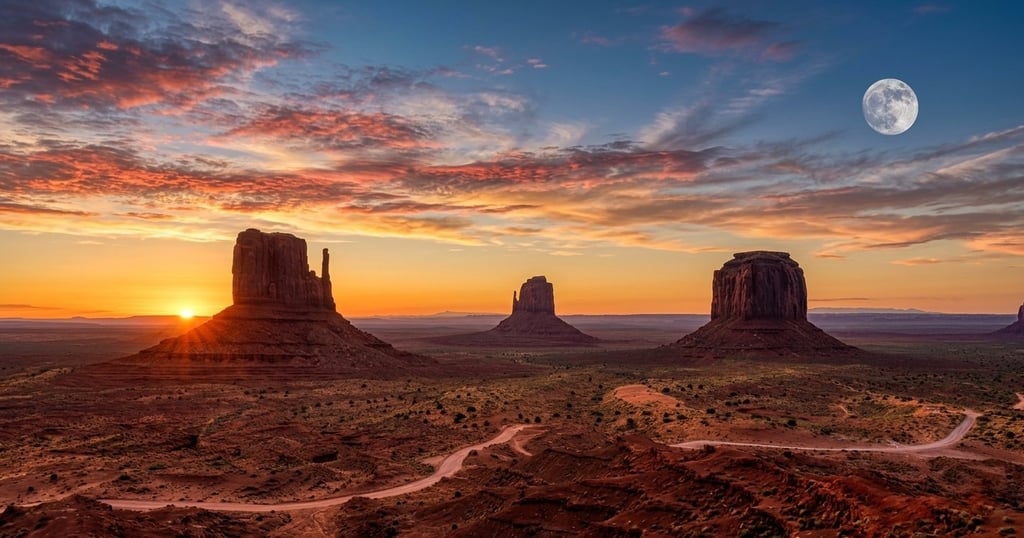
The loop opens with East Mitten, West Mitten, and Merrick Butte — the visual shorthand for Monument Valley the world has seen a thousand times in film stills and postcard racks — but seeing them in person resets the equation entirely. They're larger than expectation allows. At John Ford's Point, named for the director who made this landscape synonymous with the American West, the valley opens into a panorama so wide it seems to bend at the edges.
Further along, the Three Sisters rose in their clustered pinnacles — three figures, stone-still and ancient, standing watch over the valley floor. Camel Butte offered its own distinct silhouette; the Totem Pole and Yei Bi Chei cluster, a jaw-dropping assembly of 500-foot formations. Lit up like a jukebox, we both reached for our cameras.
The 17-Mile Loop: Monument Pass
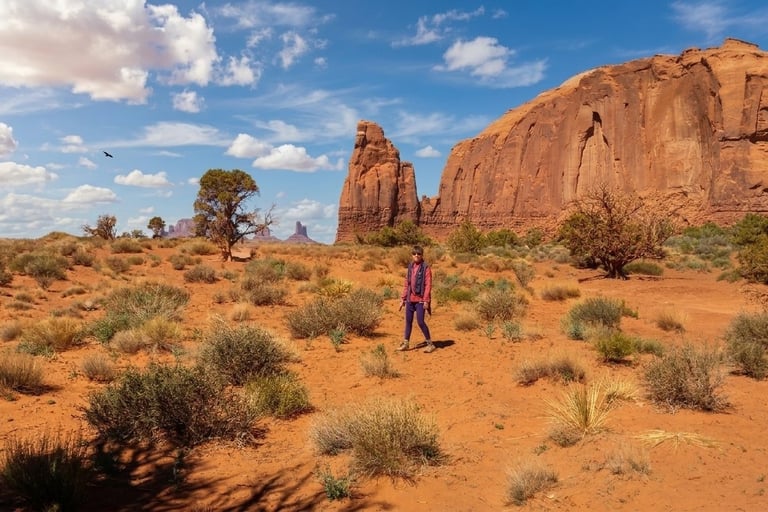
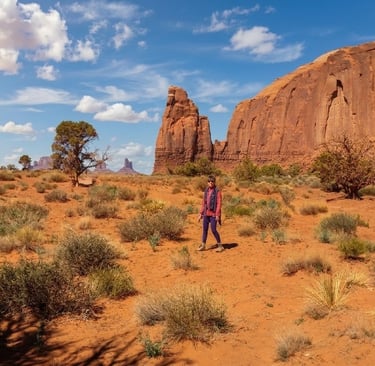
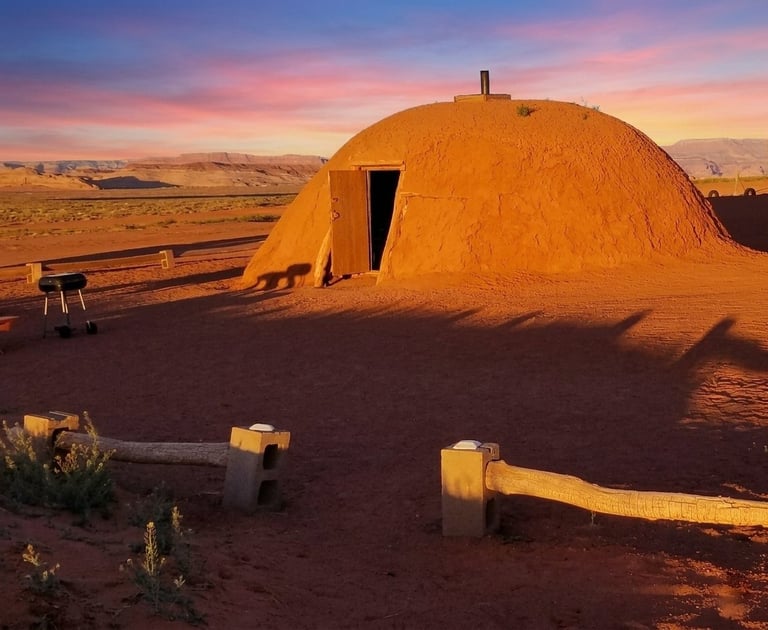
Our accommodations — completely off grid, sans electricity and plumbing — were a highlight of our Monument Valley sojourn. We felt grateful to hang our hats in Mark Holiday's traditional Navajo hogan during our stay on Diné lands. Situated in the center of Monument Valley's extraordinary territory, the "Nizhoni Hogan" (as Mark named it) is a venerated earth house that his Diné relatives use for ceremonies and for keeping themselves in balance. ("Nizhoni" translates to beautiful or pretty.)
A traditional hogan is considered a gift from the gods, occupying a special place in the hallowed world. It is consecrated through a blessing rite, the holy people invoked to "let this place be happy." The circular structure represents the sun, and the door faces east — so the sun is the first sight you see when you wake up. We were likewise delighted with our easterly view of Monument Valley's celebrated spires from the hogan door.
Our local hosts, Mark and Jennifer, shared their backstories about how the hogan is constructed of nine support poles, 12 roof poles, tree bark, grass and mud. There are no nails used in the construction — only balanced logs and mud. The oval-shaped roof symbolizes a woman's pregnant belly, and each of the nine support poles represent each month of pregnancy.
Off-Grid: Our Hogan Habitat
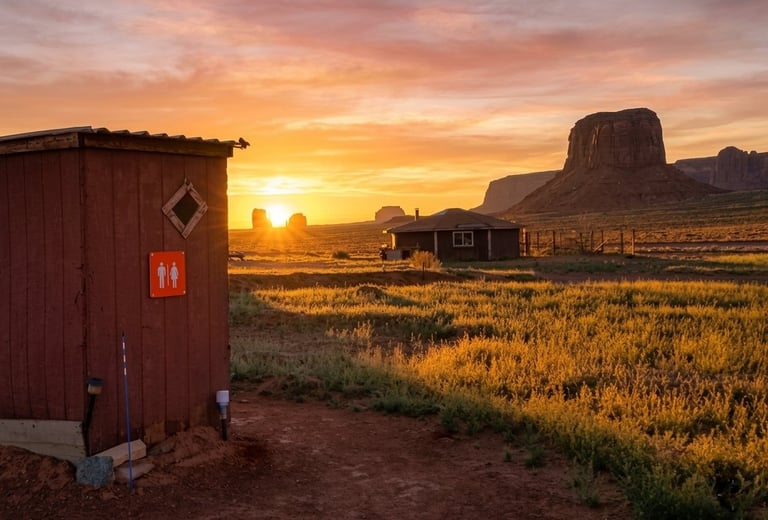
Mark showed us how to manage the wood stove, and we kept warm and comfortable under the handmade quilts crafted by the family. And then there was the outhouse. We went out the first night to discover it locked. Mark explained that toilet paper is something of a hot commodity on Diné lands, which explains the padlock. Once we located the key — kept inside the hogan, as instructed — we found our way to the facilities and discovered a wall placard that read: "Text me if you need toilet paper!" We giggled in the dark. Some things are universal.
Auspiciously, we'd planned our stay to coincide with a full moon. We brought our telescope to honor the occasion, and the moon gave us a clear, lit path between the hogan and the outhouse, augmented by the road reflectors Mark had thoughtfully tacked down along the way.
🙏 Our host, Mark Holiday, is related to Samuel Tom Holiday (1924–2018) — a renowned Navajo Code Talker from Oljato, Utah, who used his native language to create an unbreakable code during WWII. A U.S. Marine, he fought in major Pacific battles including Iwo Jima and Saipan, later earning a Congressional Silver Medal and detailing his life in the book Under the Eagle: Samuel Holiday, Navajo Code Talker. To learn more about the famed Code Talkers, we visited the Navajo Code Talkers exhibit (located inside the Burger King in Kayenta, Arizona). Watch a stirring video in which Mr. Holiday shares stories about growing up in Monument Valley, living in the family hogan, herding goats, and being "volunteered" for the U.S. Army at age 18.
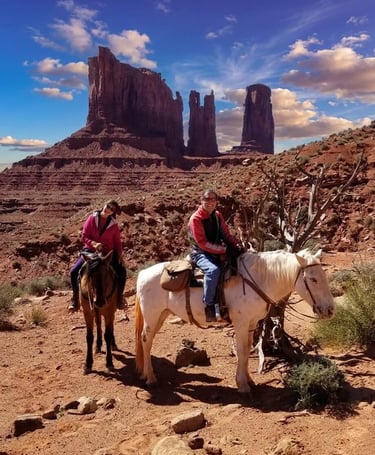
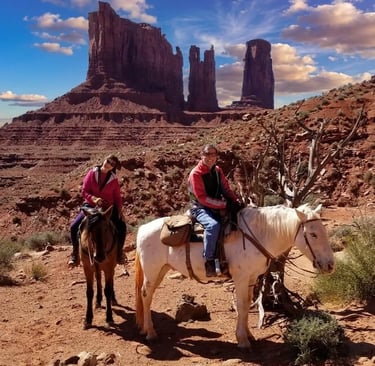
Mark arranged for his cousin to lead us on a trail ride along less-traveled paths. As the horses — Mustang and Silver — edged along the base of Stagecoach Butte, we appreciated captivating encounters with radically twisted juniper trees, and magnificent formations — among them, Castle Rock, Bear and Rabbit, King-on-his-Throne, and Saddleback Mesa.
Making friends with the equines, we discovered that Mustang fancies apples. Luckily, I had some on hand. Silver is more inclined to make frequent stops so he can nosh on grassy edibles along the trail.
Jerry wanted to holler, "Hi-ho Silver!" but refrained, fearing Silver would bolt into the desert wilderness — with him hanging on for dear life, in a cloud of dust.
Trail Ride: Into the Heart of Diné Land
The View Hotel: Front Row Seats to the Valley
Monument Valley shared with us its beauty by the mile and the millennia. Our sojourn concluded with two nights at The View Hotel inside Monument Valley Tribal Park, where every room comes with a private balcony facing the Mittens directly. Each morning, we watched the Mittens rising as dark silhouettes against a sky washed in gold, pink, and deep orange — a sight that made getting up before dawn feel like the obvious choice.
The View Restaurant served up Navajo-inspired dishes with the same dramatic backdrop, the valley floor spreading out below us over every meal. The staff were warm and genuinely hospitable — that Diné spirit of welcome was present here just as it had been at the hogan.
From our trail ride and backroading in my Toyota, to our accommodations and meals at the hogan and The View Hotel — each experience pointed in the same direction: toward a deeper understanding of what it means to live in reciprocity with the land.
To our Navajo hosts, guides, and all the Diné people who shared their land and their culture with us — Ahéhee' — thank you!
We are grateful for the recalibration and reminder that some places are not backdrops. They are centers of memory and meaning — a story still being told.
❤ v!ctor!a & Jerry
Link to Part One: Monument Valley Monoliths
Ahéhee' Nitsaago